My Training at 54

It’s a little wacky to realize my first installment in this “series” was 15 years ago!
Il tempo vola.
I’ve not hit an update for each year for two main reasons: 1-Too busy. 2-Not much new to report. This past year I’ve had a lot of change and I documented some of those changes via a post on how I’ve largely overcome chronic low-back issues and how I appear to have finally knocked some nasty chronic gut/autoimmune issues. If you want to get the most out of this piece, I recommend at least skimming those, as I’ll refer back to them frequently.
I’m not totally sure where to wade into all of this but I guess a bit of a preview of what I’ll look at might be helpful so you can decide if this is worth your time to dig in. The big topics will include:
-My current training, including strength/power work, cardio, jiujitsu, mobility, HRV tracking and some updates on the related orthopedic issues I’ve discussed previously.
-Current chow. Fortunately, my gut health (and by extension general health) has continued to improve since figuring out I had giardia, a round worm and pretty nasty candida overgrowth.
-HRT. I’ve tinkered with various angles on this that might be helpful to others, so I’ll unpack my history on that.
-Sleep, supplements, and fiddly-bits that might be interesting.
-Language learning. I’m about a year into fairly consistent Italian study. I’ll let you know what I’ve been doing, progress and why this might be both a fun and productive use of time for you.
My Current Training
For good or ill, I find I’m training most days. It’s rare that I do nothing on a given day and much of this is an outgrowth of using the Morpheus HRV app to track recovery and get a sense of how much training volume and intensity I need, both daily and weekly. First thing when I wake up each day I put on the Morpheus chest strap to get my readiness and recovery score, which includes my HRV.
The image below shows a bit of irony thicker than neutron star matter: The worst recovery score I have ever had! I’m not sure what happened but I think I ate too lightly and early the previous evening, was hungry at about 4am, woke up WAY too damn early and today is going to be a very long day. My HRV score today (I started writing this Friday, Feb 6th) was 80. For a decrepit geezer like myself, that’s not generally bad, but if you look at my trend line, this is way off my norm, which for both 14 and 30 days is about 90. The science behind HRV is pretty complex, but in general, small, incremental changes/improvements are good. Big deltas, either high or low, tend to indicate some recovery issues. My sleep last night was both shit and short, and my HRV was much lower than normal, hence the terrible recovery score. Just a few side notes on HRV:
-A big HRV increase from one day to another does not mean you are “super recovered.” It may mean your body has allocated a lot of resources into recovery…so you may be trending towards recovery, but if my HRV was normally 80, and I had a score one day of 90, I’d get similarly “dinged” in the Morpheus platform. MAYBE I can train hard that day, maybe I will pump the brakes. This would depend on my longer term plan, if I was peaking for an event (planned overload, with a taper to compete) etc.
-HRV is not remotely, in any way, comparable across platforms. Oura, Whoop etc all have their own algorithms and they cannot be compared. Apples to oranges. Any of these trends are only meaningful within a given platform. I just mention this bc folks will bring up their Oura or whoop score relative to my Morpheus score and it’s just not telling us anything. At this point, you can compare within platform, that’s it!
-MY OPINION is that the Morpheus platform is more insightful than anything else available. I have zero financial affiliation here, Joel IS a friend, but in researching the various platforms, I think this is head and shoulders above the rest, I’ll try to detail some of my thinking as we go along (and mention a few of the limitations of the platform).
Back to some of my specifics: My HRV has been in the low 90’s, resting HR about 45. This is pretty good, particularly for my age. This is an improvement from about a year ago before I addressed my gut issues when my HRV was in the low-mid 80’s and resting HR was about 55. Whatever stress I was under dealing with the gut bugs it was not leaving resources for recovery.
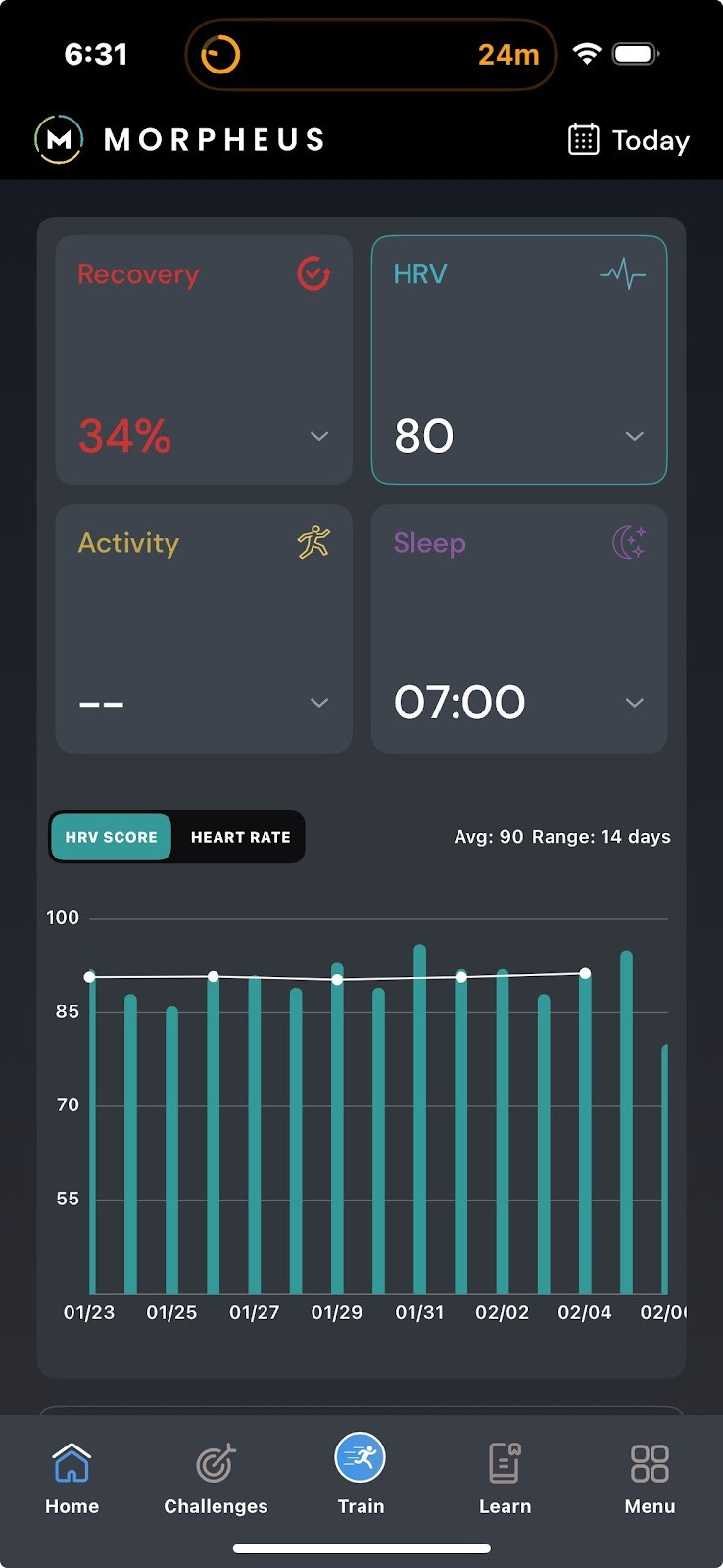
So, re the above image: BIG drop in HRV lead to a gnarly recovery score. I’m still working on this article two weeks later and I can tell you, that day sucked!
Below is a look at my weekly training zone targets and the beat per minute range the various training zones represent. This is all periodized and updated based on your age, weight, current fitness (based on max heart rate…which it sucks finding that!) and goals. Prescribed volume for the various zones shifts from week to week. Mine is likely a bit aggressive as I still have my goal set to “improve conditioning.” Toggling to “maintain” tends to reduce both volume and intensity. As you see here, By Friday of that week (starting the training week on Monday) I’ve accumulated 285 minutes of zones 1-2 (mainly at the upper end of zone 2) and 6 minutes of “conditioning” which is mainly zone 3, and still no time in “overload.”
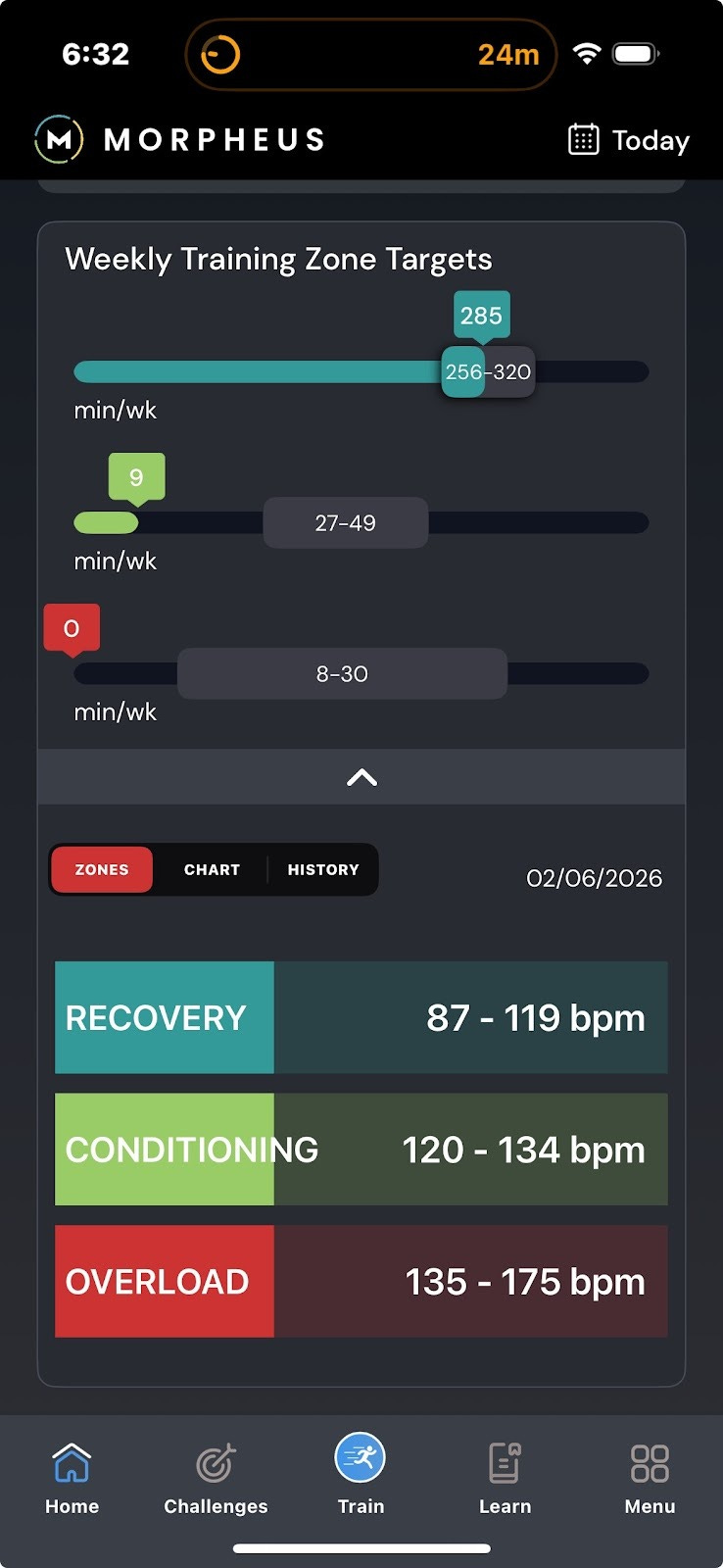
So, essentially, at the beginning of each week, Morpheus lays out a recommended amount of volume and intensity, then it is up to me to figure out how I divvy all that up. Morpheus has a boatload of articles to help you figure out how to slice and dice your training.
My normal schedule is:
-jiujitsu Monday/Wednesday
-lift+mobility Tuesday/Thursday/Saturday (covered next section)
-conditioning/mobility/fun Friday/Sunday.
How this plays out is I’ll wear my HR tracker while rolling. We typically do a 1-hour class, followed by a 1-hour open mat. Although I try to do a very low attribute, non-spastic game, the volume and intensity changes a lot depending on a number of factors. Working open guard bottom is easy. Doing takedowns is a lot of work, no matter how mellow you are trying to be.
The accumulated volume and intensity you see above is two jiujitsu classes + two open mats, funny enough, open guard bottom! with mainly Zone 1-2, with just a bit of conditioning. If the classes had been take-downs you would have seen a lot of red-zone and much more condition-ie a lot more work output and intensity. Normally, this being Friday, I’d see how my recovery is, and if it’s good, I’d do some kind of VO2 max work. I have a treadmill (set at 15% incline) C2 Rower, Ski-erg, slide board (like ice skating) and normally that’d be a 20 min warm-up followed by as hard of a pace as I can maintain for 5 min on one of the implements, let’s say, the rower. Then, I’d do 4-5 min of active recovery (usually on the slide board), then as hard as I can maintain on the treadmill for 5 min, recover on the slide board. I will typically do 4 rounds of this, and between the warm up, intervals, recovery periods, and cool down, it ends up being about an hour total, and I’ll accumulate most of all of the red zone training I need for the week, usually filling out the conditioning zone also.
So, I really orient all this around how much time I get at jiujitsu. If I get in a lot there, or if it’s higher intensity stuff, I do less conditioning at home, and or modify the intensity. I just try to fill up those various intensity ranges, one way or another. NOW, a day like today where I slept like garbage, I’ll likely do 30-40 min of zone 1.5 cardio, doing 5-10 min on an implement, then switching. What this will normally do is ADD back 5-6 recovery points due to the parasympathetic action of that work. So, if I’m fresh and I have some training zones still outstanding, I’ll get after it. If I’m smashed (like I was on the 6th) I’ll dial volume and intensity WAY back and focus on recovery so I can fight another day. What I’ve noticed with this relative to my CrossFit days is I rarely feel beat-down, I almost never get sick, I’m just about always looking forward to training. Even on a shit day sleep like I had, mentally I know I’ll feel way better after a super mellow restoration session. If I were competing, I might need to think through if I still needed a hard session that day, but I doubt I’d change much.
What’s handy about how Morpheus adapts to your situation, is my heart rate for any given zone is going to be way lower on a day like Feb 6th vs if I was recovered. It builds in some self governing elements, you just need to stick to the plan. One more thing: As great as Morpheus is, the chest strap while rolling is not great. It’ll move around, lose contact etc, so in the past I’ve used a wide ace bandage AND this super burly rib support that’s normally worn when someone has broken ribs! It keeps the monitor in place, but it’s so tight, it was uncomfortable and made breathing even harder. In poking around I found that the Coros Armband will integrate with the morpheus app. This is an optical sensor and when worn up high on the arm, between delt and bicep, it works great. I wear a rash guard over that, 2/3 of my classes are Gi, so it stays in place great. The only thing is you have to use the Morpheus chest strap to do your daily recovery score, just keep that in mind if you decide to get the Coros and then are stumped why it’s not working to do your recovery score.
So, I’m about ready to shift into the strength/mobility section but I have kind of a bridge topic, namely sprinting and stadium running. I’ve not done much sprinting for quite some time due to back issues. It was just awkward and painful to do any sprinting. AND, living in Montana, no joke, 7+ months of the year there is just not an easy way to get in sprints. I have a nice home gym in my shop, but there is not enough runway to get anything done. In talking to Sarah Strange about my training, she had a comment “Bro, do you even sprint?!” And my unfortunate answer was “no, not really.” Well, my back has gotten progressively better AND Bozeman has had the most unseasonably warm and snow-free winter in recorded history (I think) so most Sunday’s the Wolf Pack gets out as a family and we hit the local high school and do sprint interval work, run stairs etc.
I used to do stadiums a lot when powerlifting and in particular, when Thai boxing. Depending on your pacing you can work anything from exclusively a-lactic power, all the way through to a Zone 5 hell-fest. Years ago I’d do bounding from the stadium seat tops and hop up the stadium, kangaroo style, walk down. For a more conditioning orientation I’ll sprint up, walk down, and again, one can precisely control the stimulus by either straight up, quick hustle down, or walking between the bleachers to keep things more power and less conditioning.
Well, several years of a back injury and not training stuff like this left me embarrassingly weak. My first session I lacked the power and coordination to skip stairs and do two at a time. It was weird and depressing. But also VERY motivating. I realized there was almost nothing else I should be doing ahead of work like this. As we age we tend to lose power first. This is a combination of loss of the ability to fire the big, type 2b motor units and actually losing them. Things like plyometrics, sprinting, compensatory acceleration all can help stave this off, but the decline is real. I also think my essential tremor, although much better, has been a background drag in all of this process. It IS a type of neurodegeneration and does nothing to help my coordination. So, I started off in a very rough spot, but by my second session I COULD skip a step and go two at a time. I still feel kinda creaky and old but each session gets better and better. This is a high school stadium with ~30 steps, and I will sprint up, easy walk down, repeat for about 25 min. This will usually provide a lot of Green and fair amount of Red training zone on the Morpheus app if I push the pace.
So, the stair running and also some flat-land sprinting are solid fillers for my conditioning needs, but something interesting happened in doing them: My back health improved even more. It’s hard to explain, but whatever weak, achy, creaky feelings I had were improved. As I’ll get to in the next section, my back is not perfect, but man, it’s a LOT better. There is so much capacity demand with sprinting:mobility, coordination, strength, power, recovery, it’s almost like we are kinda broke if we are NOT doing that stuff.
Just to put a bow on this: my back was so compromised, I had a hell of a time sprinting, and largely did not do it. My back got better, eventually allowing me to sprint, and as a consequence of that work, it got even better.
IDK if it really fits here, but another low back unlock for me has been altering my sleeping situation. I LOVE to sleep on my left side, but it seems like I get some SI joint shift with this. To address this I’ve trained myself to mainly sleep on my back and on my right side. This has been huge. ALSO: For my back sleeping I added in a sleeping wedge. This one is usually sold for GERD/acid reflux, which is not my issue. For some reason, laying flat on my back, even with a pillow under my knees, just mildly irritates my back. I think I will address some of this below, but I suspect some tight+weak hip flexors, which I’m beginning to tinker with, but in the weeks since I’ve changed my sleeping positions, my back is “that much better.”
Strength Power and Mobility
If you have followed previous updates you might recall that John Welbourn set me up with a simple, press/pull/hinge/squat/lunge template that I have leaned into for years. In many regards, what I’m still doing is at least inspired by this approach but there is a saying that applies here: “the difference between a groove, a rut and a grave is depth and duration”. What I was doing was not just stale, the repetitious nature of what I was doing was becoming counter productive. I reached out to Sarah Strange for help because I knew I was far from a groove, and doing my damndest to turn a rut into a grave.
When Sarah reviewed what I was up to the glaring issues were: chronically excessive volume/intensity, inadequate variation in both movements and mobility activities, and as mentioned above, no sprinting. For context, I had been doing a 2-3 day per week rotation of a vertical push/pull (standing press pull ups perhaps) hinge, squat or lunge, horizontal press/pull, hinge squat or lunge. I’ve learned some FRC/KinStretch, but I’m no expert at it and over time what I was doing was incredibly repetitious which means, really not creating any type of NEW stimulus. I was (for me) doing way too much volume. Although it’s laudable to do resistance training to stave off age induced muscle loss, AND although when one digs in the literature, there is a case to be made that the more volume one does, the greater the hypertrophy signal, there are diminishing returns. One has to also acknowledge the literature is fairly clear that one likely gets about 80-85% of any possible hypertrophy signal with about 2 hard sets. A 3rd set might top that off a bit, but I was routinely doing 4-6 pretty hard sets (rep range in the 5-10 area). One CAN do this, but I really had no periodization to it. What Sarah cooked up for me was really slick and here are some of the highlights before I show you the specific template:
-She set up three mesocycles of 2 weeks each. The first is strength/hypertrophy, the second is power/dynamic effort, the third is another block of strength/power.
-Sarah worked with me to focus on some things I want to hit pretty consistently, no matter what. Dips, pullups, Nordic curls, Jefferson curls are some of those (and they are highlighted in grey below). The rest of the offerings are HIGHLY flexible and should be completely swapped out every new mesocycle. One pass through I might do DB press overhead, the next it might be push press. One might be bi-lateral, the next unilateral. KB’s one go, dumbbells the next. This is essentially the Westside Conjugate Method, but instead of mixing all these attributes in a week, it’s broken into two week mesocycles.
-Sarah totally revamped my mobility by including way more FRC/Kinstretch at the beginning of my training. Every session I hit some kind of hip, shoulder and spine work, but it’s WAY more variety than what I did previously. AND, I’m now doing this with the intent of preparing these joints FOR hard work, not doing it in a fatigued state as an afterthought, which is what I’d been doing.
This is a snapshot of the template:
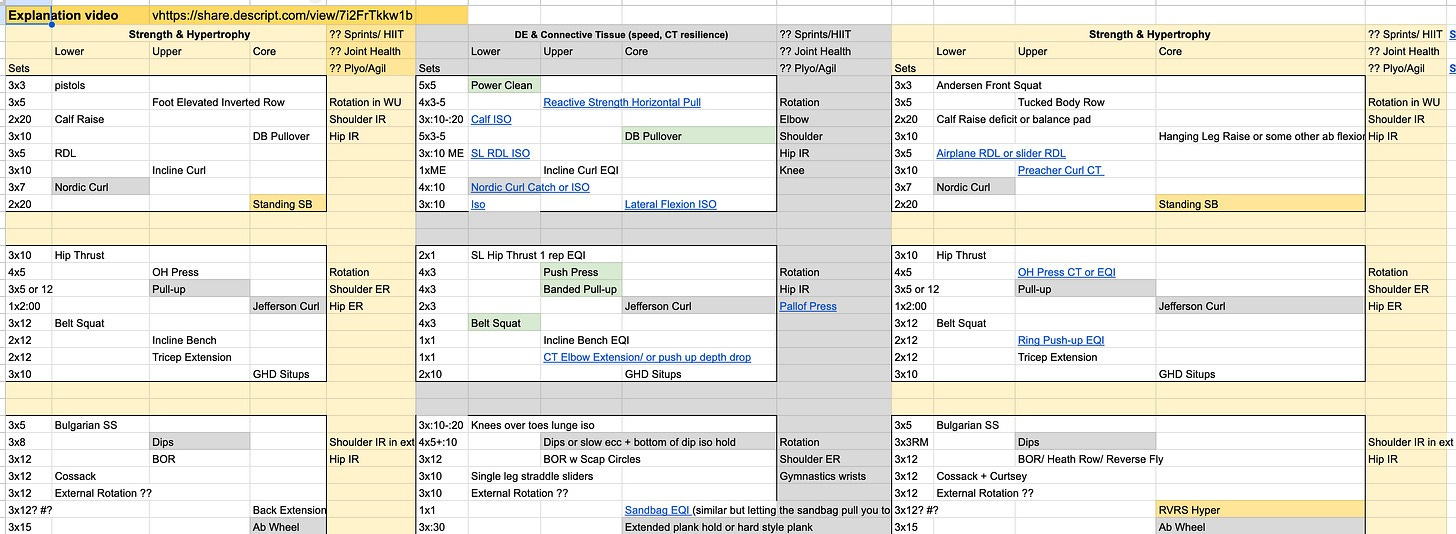
This has been both fun and really, really good for me. If I were “just” lifting and doing cardio I might be able to do a higher volume lifting program, be a little stronger and bigger, but even though I try to play a pretty mellow jiujitsu game, it always has an impact on me (as evidenced by how I feel and HRV/recovery score).
So, this is structured as 2 week mesocycles (strength/hypertrophy—>power—>strength hypertrophy). Even on the strength blocks I try to drop in some “complex training” where say, if I do a set of belt squats I’ll immediately follow that with either a depth jump, broad jump or some kind of bounding. Just 3-5 reps. Or, If I do dips. I’ll follow with a “depth jump” going from a push up position on parallettes to dropping to the floor and absorbing the impact with my arms. You have to be careful with this as it is significant loading, but this is precisely the type of stuff that erodes the fastest with aging. I think it becomes a bit chicken and egg: perhaps you get injured (like I did) you do less of this power oriented movement, then you are able to do less of this stuff, and in the background the clock is working against us.
Like I said above re the sprinting, my back has only improved. I can do fairly heavy RDL’s, and I’m slowly working my way up on Zercher squats. Any type of direct axial loading (front and back squats) can still aggravate my back, so I just don’t know if those movements will ever be in rotation again. On the squatting front however I did grab one of the Freak Athlete Hyper Pro gizmos (with a bunch of the add-ons, including belt squat) and I like the whole thing. After getting that I’ve noticed my pants fitting tighter in the legs and butt as I’ve definitely beefed up using the belt squats regularly.
One of the greatest unlocks for me has been super consistent Jefferson Curls and similar moves. Where once deep spinal flexion like that would ruin me, it’s now magic. If my back IS cranky, I can go out and do a light set and I feel great afterwards. I still have a little issue with my left SI joint sometimes shifting but that’s dramatically improved and I think some of the QL and deeper work is improving that. I ALSO still have some muted hip extension capacity with moves like an “upa” (hip bridge in BJJ). I think my hip flexors may be both weak and tight. Stretching them if they are weak is only a temporary solution, so in my next few blocks of training I’m going to hit a LOT of hip flexor work as part of my program. Also: I went into a lot of detail on my rehab in my previous back article, if you are struggling with this stuff, might check that out.
Jiujitsu
Just a very quick update on my jiujitsu training. I received my blackbelt back in September, 2025 which goes to show, if you don’t die or quit, you will “get there”. In general I’m lucky if I get 2 days per week of training, and on those days it’s typically a 1 hour class, followed by an open mat for an hour. At the open mat I devote about 80-90% of that time to specifically drilling either the material we covered in class, or an area I’m focussing on. I find one gets better, faster with this type of training, and it seems to be a bit safer as you can control the parameters a lot more. On the safety topic, I’ve finally reached the point where I have to be more selective about who I train with. Other than specific situations, I’m generally not going to do much training with anyone more than about 50-60lbs heavier than myself (I’m 170’ish). There was a time when I’d roll with literally anyone (for example, I trained with Shawn Baker and John Welbourn when they visited!), but I’m now at the spot where some of the young guys may be 25-30 years younger, 50-100lbs heavier. Some rare exceptions, I’ll do some specific positional drilling with these folks, but otherwise, the risk/reward is just not favorable.
If you are an older grappler, I’d seriously consider the nuggets offered here. Do mainly positional drilling vs open mat, be smart about who you train with. I think this could keep you in these arts until you expire. Helio Gracie died at age 95. For abut the last 30 years of his life he mainly did positional drilling, and was selective in who he trained with. It’s my understanding he was training up until about 2 weeks before he died, then he got sick, and that was it. That strikes me as a damn good run.
Chow
I’ve not changed much on my food since the article where I described my journey in figuring out my long standing gut and autoimmune issues. If you recall from that piece, I’d introduced a good bit more variety, including some fermentable fiber sources. I’m about 9 months down range on all of that and thankfully, things just seem to be getting a little better all the time. I did have one interesting backslide however: Since reading the book Lights Out: Sleep, Sugar and Survival back in 2000 I’ve usually tightened up my ketogenic eating during the winter months. This has always worked well for me, but this time, things went sideways. I started getting weird “whoosh” effects. I was pretty panicked thinking perhaps an infection had come back, so I ordered a Genova Diagnostics stool test and decided to reintroduce some fermentable fiber in the form of more fruit, an occasional piece of GF sourdough bread, cashew butter etc. and within a day things were better.
Ages ago, Paul Jaminet (Perfect Health Diet) speculated that a very low carb diet could be problematic because there might be inadequate substrate to feed the mucus layer of the intestines. The counter to this is fermentable carbs are not the only thing that can fuel this AND when in ketosis, beta-hydroxybuttyrate can enter the colonic tissues and gut, and in theory replace the butyrate and propionate that’s produced via fiber fermentation. When I received my Genova report I was pleasantly surprised: not only did I not have any pathogens, my previously leaky gut was great, my diversity was “good.” When I was sick my gut permeability was awful, I had terrible diversity and what I did have was of a fairly nasty variety...and about all I could tolerate was fatty red meat.
The funny thing in all this is the hardcore keto/carnivore folks will be aghast at including plants and 50-80g of carbs per day. Most of the mainstream think that’s still way too few carbs! All I know is I feel great, better than just about any point in the past 15+ years. But I promise you, when I post this, particularly over on X, even though my health is better in every objective and subjective measure, someone will tell me I’m fucking up something!
On the accounting side my estimated basal caloric needs is about 2,400 cals. On hard training days I may expend up to an additional 1,000 cals. But this is again where the Morpheus platform is nice as it gives me a pretty good sense of my total caloric expenditure for conditioning sessions, but it’s awful for estimating caloric burn for strength work (it estimates about 2X-3X too high). Lifting days might add 200 cals extra, conditioning days, up to a 1,000 cals. I tend to do three meals, maybe a snack here or there. I tend to build a meal with about 40-50g of protein, I keep denser carbs under about 25g, and then I add fat to what I need. On a lift day I shoot for about 800 cals per meal, on a cardio day it’ll be closer to 1200 cals per meal. I use Cronometer to track all this and it’s pretty easy. This may seem neurotic, but left to myself, I will chronically UNDER eat.
Circling back to that little episode where my guts kinda worsened with very low carb: IDK what’s up with that. Was it a one off? Was it due to too few carbs causing a mucus layer issue in my guts? Again I don’t know. What I do know is that I’ve been feeling a little better week by week for nearly a year now, and this amidst eating a LOT more variety, which the keto-carnivore extremists will want to vote me off the island, but I’m just happier having a bit more variety! I don’t check ketones often but I’m still in the 0.5-1.5mm range just about every time I check in on that. I know there are folks who do not seem to need, and certainly do not want, to add in more carbs. That’s great! For them. I’m kinda liking this, being both healthier AND having more variety in my diet. At the end of my health update I made the case the goal (IMO) should be resilience, not a gold medal for how limited a diet I can eat and not hang myself with piano wire. And, yes, I fully get that some folks end up with a meat only diet and that’s the only thing that works for them, I’m not shitting on that. I lived it. But I think too many in the space put a premium on extremism. As a side note, I remember a piece by Sami Inkinen (Virta health co-founder, I believe early PayPal with The Musk) from ages ago when he described using up to 300g/day of carbs during hard bike racing. Here’s an excerpt from that:
“How many carbs could I eat to stay in ketosis: My BOHB values were all above 1.0mmol/L (generally above 0.5mmol/L is considered “nutritional ketosis”) with up to 200grams of carbohydrates ingested in one sitting right after the stage. Adding up the nutrition during the race, I consumed 300grams of more of carbohydrates per day, yet was in ketosis each morning when waking up. This is obviously highly dependent on the amount of exercise and carb oxidization during the race. Yet, it was surprising that I was able to fill up the muscle glycogen tanks after each race day, yet keep burning fat for primary fuel.
Are those 100-150grams of carbs needed right after each stage: I don’t have a definite answer how else to restore glycogen levels for a back to back 2-6hour all out effort the next day. That amount seemed to be enough for me and I felt ready to go as hard as needed the following day. Based on this experience, I’d say it seems to help.”
I don’t know what’s right for you, but I do know that when one is turning over more than 1,000 calories from a hard training session (be that jits, biking, or cardio-circuits) it MIGHT alter one’s ability to handle some additional carbs. Just as a reminder, my max daily carb intake rarely goes above 80g, and that level is on my harder, higher volume/intensity days.
HRT, Supplements and other Fiddly Bits
The long and short of my HRT experience is that about ten years ago I started using first Clomid, and then Enclomiphene, to augment my testosterone. The mechanism of action for both drugs is they block certain estrogen receptors in the brain, which interestingly, then cause the brain to begin the hormonal cascade of producing testosterone. This might seem counter intuitive, but in both men and women, a fair amount of the estrogen they experience is produced as a consequence of testosterone being converted to estrogen via the aromatase enzyme found in adipose tissue.
The only real difference between the two drugs is enclomiphene is only the active isomer, whereas Clomid is a mix of both the active enclomiphene isomer, and a form that does not stimulate testosterone production, and actually can have some negative side effects like vision alterations (which I’m one of the lucky 1% of people who had that experience with clomid).
I underlined producing above as it’s a very different overall process to stimulate testosterone production vs supply it exogenously. Under ideal circumstances one would produce solid levels of androgens throughout life, but for a host of reasons, modern men seem to be having significant problems on this front. That paper suggests this downward trend is independent of obesity, which is kinda scary. One thought is simply being overweight can overly convert testosterone into estrogen, which understanding how T is made, begins a terrible downward spiral: The brain senses too much estrogen due to excess conversion, so the individual produces less testosterone, they feel like shit, get poorer body comp, etc, etc.
Too much bodyfat driving low T levels IS a thing, and also why one should tackle diet and lifestyle before tinkering with any type of HRT, but it does also become a bit chicken and egg: low androgen levels means kinda poor results, not feeling great, slower adaptations. If folks want a deeper dive on all this I can do it in another piece, but the long and short is if one is significantly overweight it’d be smart to really think through how you are approaching HRT. Just adding more T to a system that’s rapidly converting things to estrogen is going to be a mess.
Ok, back to my situation, I started using enclomiphene (25mg/day at bedtime) and I had pretty solid results. Total testosterone at the high end of normal, and generally felt pretty good training, no side effects etc. As you recall from my aforementioned health updates, I managed to catch several gut pathogens and those damn things ground me down to a nub over about 6 years. I kept feeling worse and worse and not surprisingly, my testosterone levels were on a gradual downward slide. About three years ago I started using testosterone cypionate (200mg/ml) as a daily subcutaneous injection of ~0.08ml which is about 16mg/day (200mg/ml X 0.08ml=16mg). That bumped my levels back up, but if you recall, I was still on a pretty terrible downward spiral overall. The past 9 months I’ve felt better and better and I’m contemplating tapering off the testosterone and seeing if the Encyclophine can get me what I want. Why? My thinking on all of this is to stay as close to natural processes as possible and to do as minimal an intervention as possible. This is an abbreviated cholesterol to testosterone synthesis:
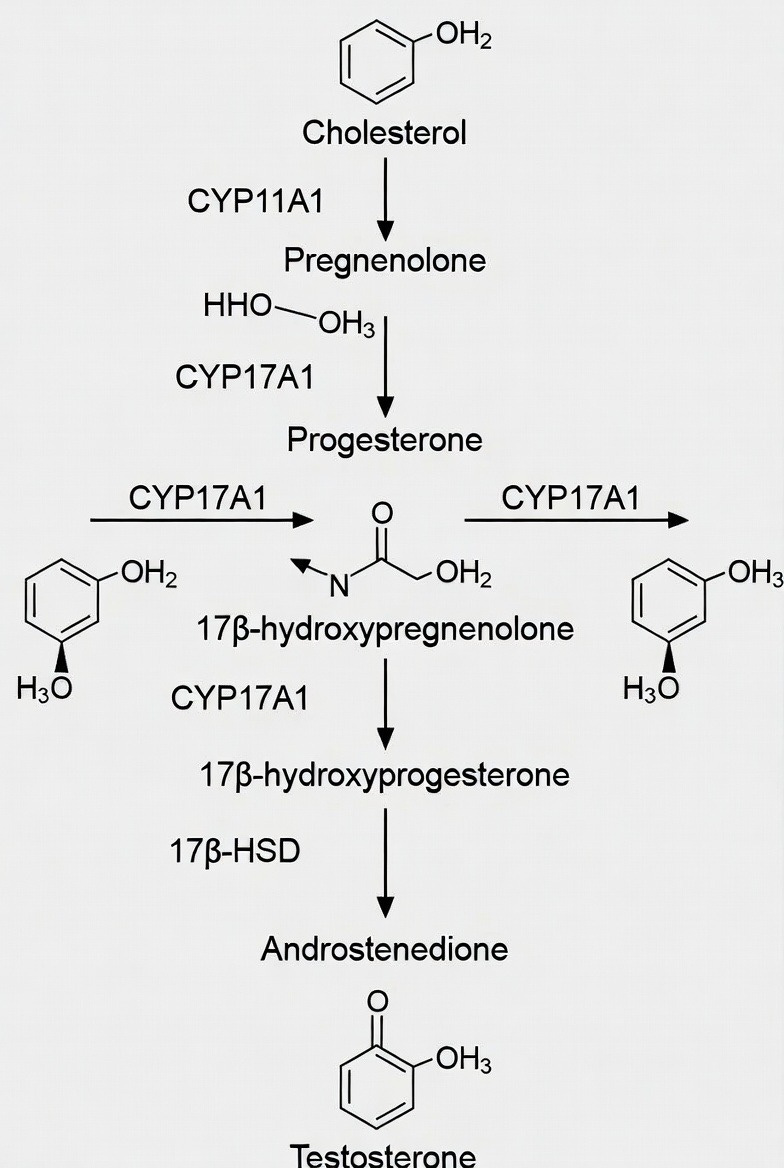
There are all kinds of intermediates in that mix that are bypassed when going straight to testosterone. I honestly don’t know how much of a difference it is, how much impact there is between one method vs the other, but I just have a gut sense that one might want to stay as close to natural processes as possible (due to intermediates having their own effects) and to get as much runway as possible. Could I goose things with enclomiphene until I’m 65, then if that’s failing, switch back to testosterone? I’m not sure, but that’s my plan and I’ll update how that plays out.
As a quick side note on some important points: HRT for both men and women has experienced a bit of a renaissance within even mainstream medicine due to a number of findings dispelling various health concerns. It’s still going to take a long time for your standard MD to get up to speed with this, but the view of HRT is changing. It’s also critically important to understand that there absolutely is a “U” curve with regards to HRT. It certainly looks like abnormally low levels may present problems, but the higher end, particularly going super-physiologic, has its own issues. Hair-loss, prostate issues, abnormally elevated hematocrit are all legit concerns, and why, again if I were to tinker with this stuff I’d monitor closely and be careful of things too far into the high normal range.
I do take some other supplements and pharmaceuticals, and I’ll kick that off with how I tackle vit-D.
I get 5,000IU of vitamin D3 (with K2) per day from QuickSilver Scientific. It’s kinda pricey but it tastes great and is the first product I’ve been able to get Nicki and the girls to use regularly. I also tend to use a Krypton 1612 daily. This is a combination UVA/UVB/IR set up. I have worked up to 5-10 min per side most days. My best estimate is that 5 min per side is likely giving me an additional 5,000 IU of vit-D from UV-B. I use the D-minder app to track all of this and also use the app to track Vit-D production during the 3-4 days per year one can make Vit-D outside in Bozeman! It’s not quite that bad, although we are fairly far north, we are also over 5,000ft elevation. I’m working on a separate piece on photoperiod, sun exposure etc so I’m not going to dig into this too much here, but a reasonable question to ask: “is there not a risk of skin cancer with that Krypton and also direct sunbathing?” And the answer to that is “yes” but the picture I’ve seen reinforced over the past 20 years is that one’s skin cancer risk increases some nominal amount, while one’s likelihood of all other causes of death drop precipitously. I guess the joke will be on me if I end up with some kind of incurable skin cancer, but I feel way better doing this process and am OK with the risk profile here.
The next block of supplements/pharmaceuticals I take are largely oriented towards cardiovascular function and health: Arterosil +5mg/day of tadalifil. These items support nitric oxide production and that looks like a smart move for vascular health. I also use a Natokinase (20,000 units) supplement for its effects in clotting, and bergamot (!500mg/day) which acts as a mild pcsk9 inhibitor. The long and short is that ALL of these items seem to correlate with some nominal improvements in CV health and function. I guess you could lump tea and coffee into this as well.
I try to get in either sardines or salmon several days per week, if I don’t get some in a given day I’ll do ~15ml of fish oil from someone like Nordic Naturals.
I do 5g of creatine most days, I’ve tried to ramp that up with all the recent hype about 20g doing wonders for folks, but I have to break it into multiple servings or I get the trots!
On the sleep side, I mainly do Doc Parsleys product although I often will rotate between that and magnesium threonate and about 1mg of sublingual melatonin. IDK why I rotate things, just started doing it and as evidenced by my HRV/recovery, it seems to work pretty well. Although not specifically a sleep aid, I do also take 4mg of low dose naltrexone at bedtime. I started taking LDN years ago when I had all the gut issues. I don’t know if I still need it, and may try rotating it out, but I’ve just been in the habit of using it for so long, I’ve just kept rolling. Even as sick as I was, the LDN for sure helped mitigate some of my autoimmune issues, so I’f I notice any negative side effects from removal, I’ll absolutely start it again.
I’m sure I’m forgetting something, but that’s the lion’s share of supplements and pharmaceuticals I’m using currently. Now that I’m actually feeling better I’m looking into some things like peptides, myostatin inhibitors and similar to add some muscle mass and try to forestall muscle wasting. I’m still quite early in my investigations with this, but I think there are some promising options. I’m not looking to be a competitive bodybuilder, and I’m not willing to do things that I suspect will be antagonistic to longevity. I’m just looking for high reward, low risk options that might squeeze a bit more juice out of this chassis.
Before I briefly talk about language tinkering I did want to mention two interesting improvements I’ve experienced over the past 9 months since dealing with my gut issues. Previously I had some non-trivial prostate issues (I’d have to pee like 5x before finally going to bed) and I had some male pattern baldness occuring. Interestingly, both of these issues have dramatically improved! This is just a guess, but candida can alter prostaglandin production. What’s confusing to me is PFE2 production appears to be protective against hairloss, so mechanistically, I’m just not sure what was happening here, all I know for sure is these issues have dramatically improved.
Language Tinkering
This piece is way longer than I’d initially intended, and I’ll expand upon this language section in a later, separate piece. But the back story is last May we went to Italy with a bunch of the family for Nicki’s dad’s 75th b-day. It was fantastic, and in the run up to that, I started studying Italian. I was Ok in Spanish from my high school and travel days, so I was not starting from a complete dead-stop (verb conjugations are quite similar for example). All I can say is I’ve absolutely fallen in love with Italy, the Italian language and the whole process. There is a ton of research painting later life language tinkering as highly beneficial for brian health and neuroplasticity. That’s great, and I’ll take it, but the main thing that keeps me doing it is that I really, really like it. I’ve had just over a year of tinkering and my spoken capacity is in the B1 level so long as the topics are reasonably familiar, the accent is not too crazy (some parts of Italy have wildly divergent accents). My reading and listening capacity is quite a bit ahead of that, I can understand far more than I can communicate verbally, which I guess is pretty normal.
I’m no language savant, but in a year, with some consistent effort, I’ve made remarkable progress. I’ll detail everything I’ve been doing in this follow up piece, but I’d strongly encourage you to find somewhere you want to go, a language you want to learn, and get after it.
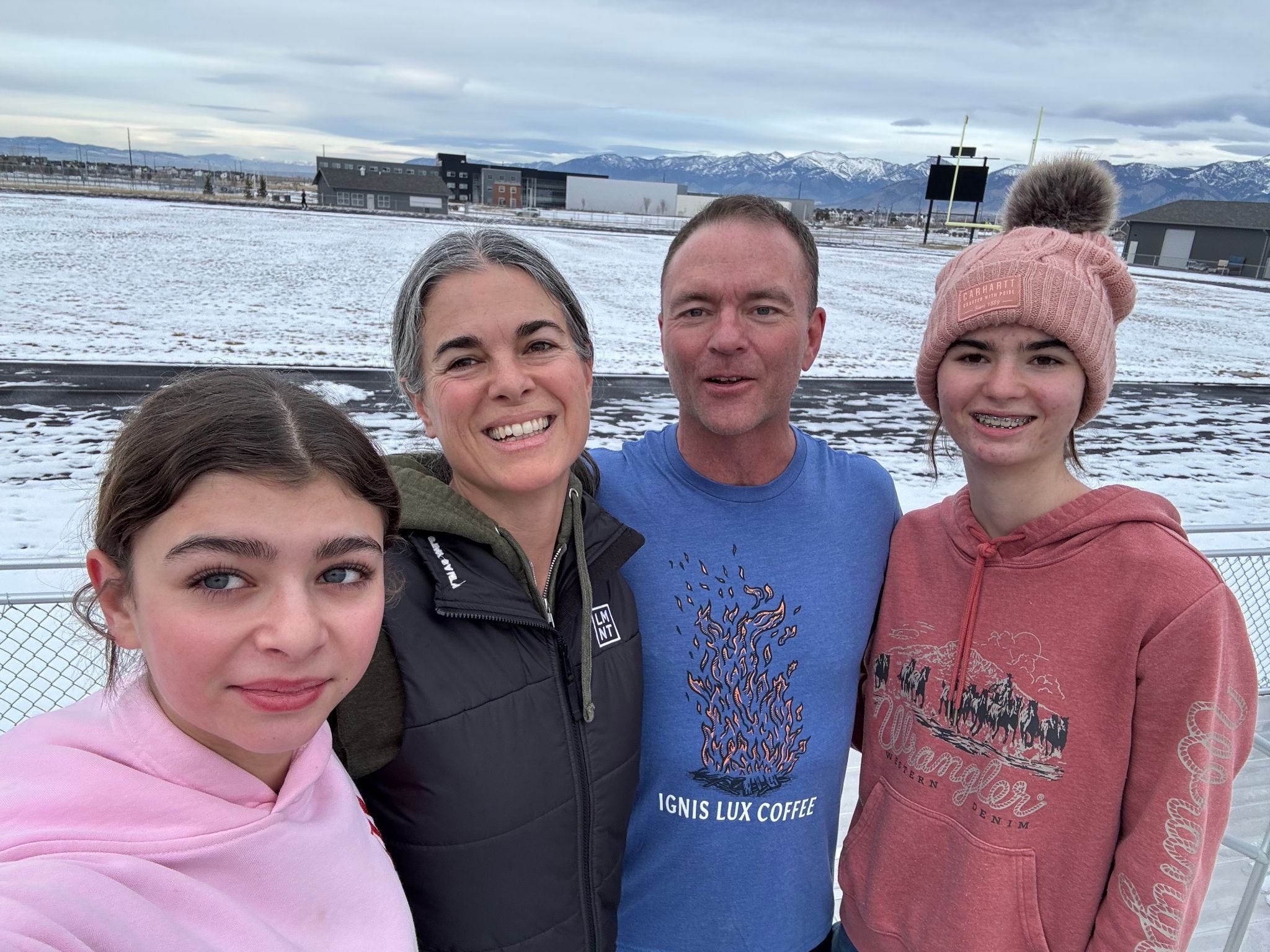
Ok, I think that’s it for this year! I am very grateful to see my health continue to trend in a favorable direction. If you have any questions, please do drop them here and I’ll do my best to answer them. I usually do some kind of update pic, this one is me and the family after a sprint session at the local high school. This is why I try to stay in shape, be as healthy as I can. To do fun stuff with my family and be as positive an influence in their lives as possible.
Thanks, Robb, really great that you’re up for putting this much effort into an update like this. Really helpful to read, not so much for the specifics which of course are very specific to you as an individual, but to get a sense of your process and how you think about this over time and evolve your approach in all these areas.
Awesome stuff Robb! I love all the context around each topic leading to a better idea of the protocols! Keep crushing it buddy!